
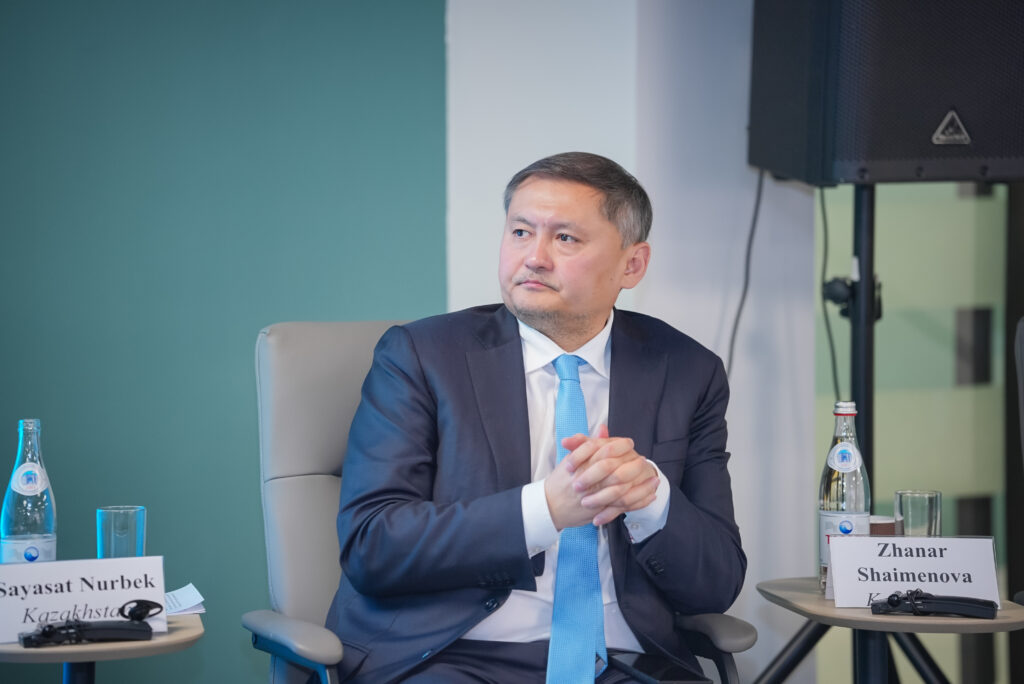
by Sayasat Nurbek, Minister of Science and Higher Education of the Republic of Kazakhstan
Central Asia is entering a new phase of regional integration. The region is becoming increasingly interconnected: economic ties are strengthening, cooperation between states is expanding, and transport and digital infrastructure are developing. Higher education is also becoming an important part of this process. Universities are launching joint educational programms, branch campuses of leading international universities are being established across the region, academic mobility of students and faculty is growing, while research is increasingly carried out through international partnership. Yet while knowledge, ideas and talent cross state borders ever more freely, the same cannot yet be said of qualifications.
A diploma obtained in one country often requires lengthy verification and recognition procedures in another. Researchers face administrative barriers when building international academic careers. Employers are not always able to objectively assess qualifications earned abroad. The rapid growth of digital education, micro-credentials and new forms of learning is placing additional demands on states – demands that existing recognition systems are not yet fully equipped to address. A fragmented system of qualification recognition has become a kind of tax on regional integration, one that students, researchers and specialists crossing our borders are forced to pay.
Recognition of qualifications is therefore no longer solely a technical or administrative procedure. It has become one of the key conditions for developing human capital, sustaining academic mobility, advancing regional integration and securing sustainable economic growth. Kazakhstan regards the recognition of qualifications as a strategic element of modern education policy and of the future Central Asian Higher Education Area.
From national reforms to regional cooperation
In recent years, Kazakhstan has consistently pursued large-scale reforms in science and higher education. The country is expanding international academic cooperation, welcoming branch campuses of leading foreign universities, modernizing the training of scientific personnel, creating new research-financing mechanisms, and introducing modern educational technologies, including artificial intelligence. All these transformations pursue a single goal — building a competitive higher education system capable of training world-class specialists and participating in the global scientific space.
However, the effectiveness of any education reform is determined not only by the quality of training within a country. It is equally important that the results of this education be recognized beyond its borders. A graduate who has studied at a Kazakhstani university should be able to use that qualification in Bishkek, Dushanbe, Tashkent, Seoul or Frankfurt, without having to spend months overcoming bureaucratic uncertainty. Research teams should be able to form freely regardless of state borders, and employers should be able to trust qualifications obtained in neighboring countries. This is one of the necessary conditions for the full integration of education systems.
A first step toward a shared system of trust
In February 2026, Kazakhstan became the first country in Central Asia to ratify the UNESCO Asia-Pacific Regional Convention on the Recognition of Qualifications in Higher Education (Tokyo Convention). This step was not a formal fulfilment of international obligations.
Ratifying the Tokyo Convention was not an act of administrative compliance, nor simply another international commitment. It was a deliberate statement that Kazakhstan is prepared to participate in a rules-based international framework for the recognition of qualifications and to build the institutional capacity necessary to make that commitment meaningful.
Recognition of qualifications cannot be built solely on bilateral agreements or the case-by-case assessment of individual diplomas. A modern higher education system requires common rules, clear procedures and transparent mechanisms for assessing the quality of education. It is precisely this foundation that UNESCO’s Recognition Conventions create. They make it possible to build a common language of trust between the education systems of different states and provide predictability for students, universities, researchers and employers.
For Kazakhstan, participation in this system means not only accepting international obligations, but also a readiness to improve national mechanisms for recognizing qualifications in line with the best global practices.
Central Asia: time for joint solutions
Today, the countries of Central Asia have a unique opportunity to build a shared education space founded on trust and mutual recognition.
The region has changed significantly in recent years. Cooperation between universities is expanding, joint educational programs are emerging, the number of international students is growing, and academic exchanges and cross-border research projects are developing. These processes call for modern mechanisms of qualification recognition capable of ensuring the free movement of knowledge, competencies and talent.
This is why the implementation of the Turkestan Declaration on the Central Asian Higher Education Area (CAHEA), together with the further application of the Tokyo Convention and Global Convention, is of particular importance.
Kazakhstan is convinced that the development of the Central Asian Higher Education Area is impossible without mutual trust between education systems. This trust is not built through individual negotiations over each diploma, but through transparent, understandable and verifiable international mechanisms. It is precisely UNESCO’s Recognition Conventions that give us a common language of trust. Our task is to learn to speak this language fluently.
Leadership through partnership
Kazakhstan became the first country in the region to ratify the Tokyo Convention, but this step has never been regarded as an element of competition. On the contrary, Kazakhstan sees its decision as an invitation to further regional cooperation.
The more countries adopt shared principles of qualification recognition, the wider opportunities become for students, faculty, researchers and employers across the entire region. In today’s world, competitiveness is defined not by the ability to act alone, but by the ability to build partnerships based on trust and common rules.
It is precisely this foundation that is created by UNESCO’s Recognition Conventions and by the work of the Asia-Pacific Network of National Information Centres (APNNIC),contributing to the development of open, transparent and interconnected education systems.
Looking ahead
The future of higher education cannot be imagined without international cooperation. As educational pathways become more flexible and professional careers increasingly extend beyond a single country, recognition of qualifications is becoming one of the most important factors in the development of human capital.
For Kazakhstan, this is not a matter of administrative procedure. It is an investment in trust. An investment in youth mobility. An investment in the development of science. An investment in the future of Central Asia as a single higher education space.
Kazakhstan has taken the first step. We hope it will not be the last in our region. Together, through the UNESCO Recognition Conventions and regional partnership, we can build a higher education area where qualifications open doors rather than create barriers.