

Collaboration among stakeholders throughout the Asia-Pacific region is becoming increasingly important for developing quality and relevant lifelong learning systems. Technical planning documents, such as qualification frameworks, aim to promote transparency around expected learning outcomes.
What is a qualifications framework?
A qualifications framework is a system for the classification, publication and organization of quality-assured qualifications according to a set of criteria.
National qualifications frameworks in general comprise all the qualifications in an education system of a State Party, or of a constituent unit thereof, or can be sector specific. Such frameworks describe how the various qualifications they include relate to each other, in a lifelong learning perspective, and they outline learning paths through which learners can move within the corresponding framework.
Regional qualifications frameworks also aim to facilitate the recognition of qualifications within and, at least to a certain extent, between regions. Regional qualifications frameworks provide a means of cross-referencing national qualifications with commonly agreed international frameworks, and serve as informal references for countries and education systems outside the regions to which they formally apply.
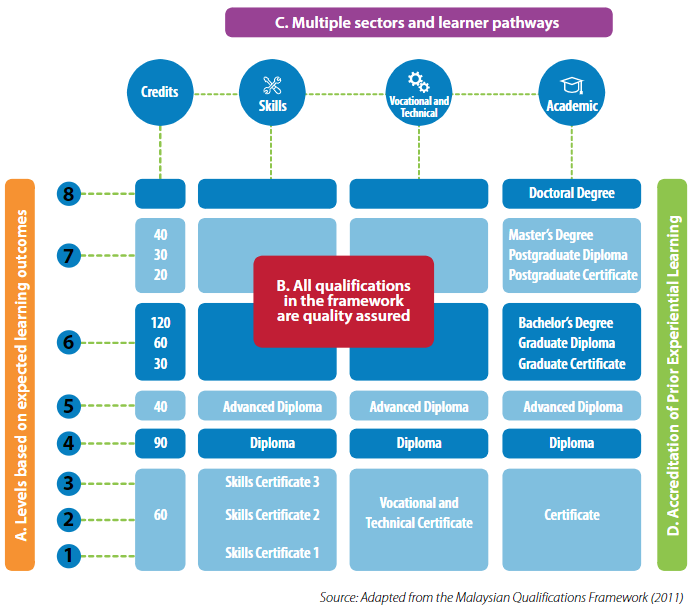
Main features of a National Qualifications Framework (NQF):
- Levels based on expected learning outcomes – Most commonly, NQFs describe tertiary qualifications based on levels of knowledge, skills, competencies, values and attitudes, etc. NQFs provide a basis for the development of different levels and types of qualifications, as well as their vertical and horizontal connections, and the establishment of equivalences (e.g., how academic and vocational qualifications compare).
- Part of a system of quality assurance policies – An effective system of quality assurance is fundamental to support a well-functioning NQF.
- Multiple sectors and learner pathways – While diverse, NQFs tend to be inclusive of all tertiary education and training sectors and learning pathways (e.g. Technical Vocational Education and Training and higher education institutions, and cover public and private institutions).
- Embrace different ways of learning – NQFs often include different modes of learning, including formal, non-formal and informal learning, so that outcomes are comparable, recognizable and transferable, and thus contribute to lifelong learning. Accreditation of Prior Experiential Learning (APEL) is one example of how authorities can consider flexible learning pathways.
Qualifications frameworks do not work in isolation from quality assurance and qualifications recognition.
Learn more
- Asia-Pacific Regional Convention on the Recognition of Qualifications in Higher Education (Tokyo Convention)
- Global Convention on Recognition
- Developing Holistic Indicators to Promote the Internationalization of Higher Education in the Asia-Pacific (UNESCO, 2018)
- Guidelines on Implementing Qualifications Frameworks in Asia and the Pacific at Subject Level: Educational Studies and Cultural Heritage Management (UNESCO, 2020)
-
Global Convention on the Recognition of Qualifications concerning Higher Education: operational guidelines – UNESCO Digital Library (UNESCO, 2025)
- The ASEAN Qualifications Reference Framework (AQRF)
- Pacific Qualifications Framework | EQAP